Metrics and analytics
Inbound marketing is measurable in a way traditional advertising never was. The challenge is not a lack of numbers but a glut of them. This page covers the metrics that actually matter — the ones that connect marketing activity to business outcomes.
Traffic and its quality
Traffic is the top-of-funnel signal: how many people are finding your content, and through which channels (organic search, direct, referral, social, email, paid). But raw traffic is a vanity metric on its own. What matters is qualified traffic — visitors who match your audience and engage meaningfully. Time on page, pages per session and scroll depth help separate genuine interest from accidental clicks.
Conversion rate
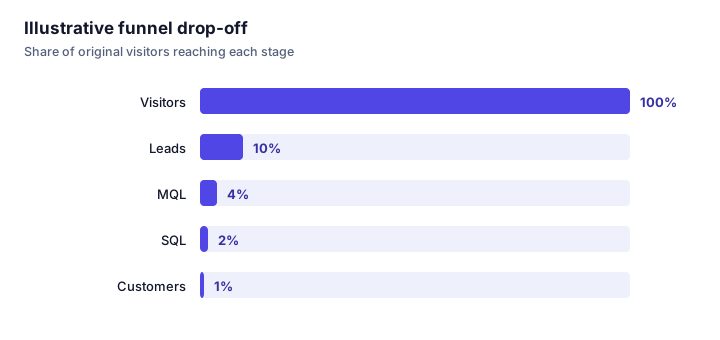
Conversion rate is the share of visitors who take a desired action — subscribing, downloading a lead magnet, requesting a demo. It is the hinge between traffic and pipeline. A small improvement in conversion rate can be worth more than a large increase in traffic, because it compounds across every visitor you already have. Teams track conversion rate at each stage: visitor-to-lead, lead-to-MQL, MQL-to-SQL, SQL-to-customer.
CAC: customer acquisition cost
Customer Acquisition Cost (CAC) is the total sales and marketing cost to acquire one customer, over a period, divided by the number of customers won. CAC is the discipline metric: it forces you to ask whether your inbound programme is economically sustainable. Inbound's promise is a falling CAC over time, as content keeps attracting visitors long after it was produced — unlike paid ads, whose cost recurs with every customer.
LTV: lifetime value
Lifetime Value (LTV) is the total revenue (or profit) you expect from a customer over the whole relationship. The crucial number is the LTV:CAC ratio. A widely-cited rule of thumb holds that a healthy subscription business wants LTV to be roughly three times CAC: enough margin to fund growth, without overspending to acquire customers who do not pay back. If CAC approaches LTV, the model is in trouble.
The MQL-to-SQL rate
The conversion rate from MQL to SQL measures the health of the handoff between marketing and sales. A low rate suggests marketing is passing over leads that sales does not consider ready — a sign the MQL definition is too loose, or nurturing is not maturing leads enough. A high rate with low close rates can mean the opposite. Watching this metric keeps the two teams honest with each other.
Attribution models
Most customers touch several pieces of content before they buy. Attribution decides how much credit each touchpoint gets. The common models:
| Model | How it assigns credit |
|---|---|
| First-touch | All credit to the first interaction — good for understanding what attracts. |
| Last-touch | All credit to the final interaction before conversion — simple but ignores the journey. |
| Linear | Equal credit to every touchpoint — fair but undifferentiated. |
| Time-decay | More credit to touchpoints nearer the conversion. |
| Position-based (U-shaped) | Most credit to the first and last touch, the rest split between. |
No model is “correct”. Each tells a different story; mature teams look at several together rather than trusting one. The point of attribution is not perfect accounting but better decisions about where to invest.
A note on dashboards
The temptation is to track everything. The better practice is to choose a small number of metrics that tie directly to revenue — qualified traffic, conversion rate, CAC, LTV:CAC and pipeline contribution — and review them regularly. A dashboard that no one acts on is just decoration.
Frequently Asked Questions
- What is a good LTV to CAC ratio?
A widely-cited benchmark for subscription businesses is around 3:1 — lifetime value roughly three times the cost of acquiring the customer. Much lower and the economics are fragile; much higher can mean you are under-investing in growth. It is a guideline, not a law, and varies by industry.
- Which attribution model should I use?
There is no single right answer. First-touch shows what attracts people; last-touch shows what closes; multi-touch models like linear or position-based spread credit across the journey. Most experienced teams look at several models together rather than relying on one, and use them to guide investment rather than to settle arguments.